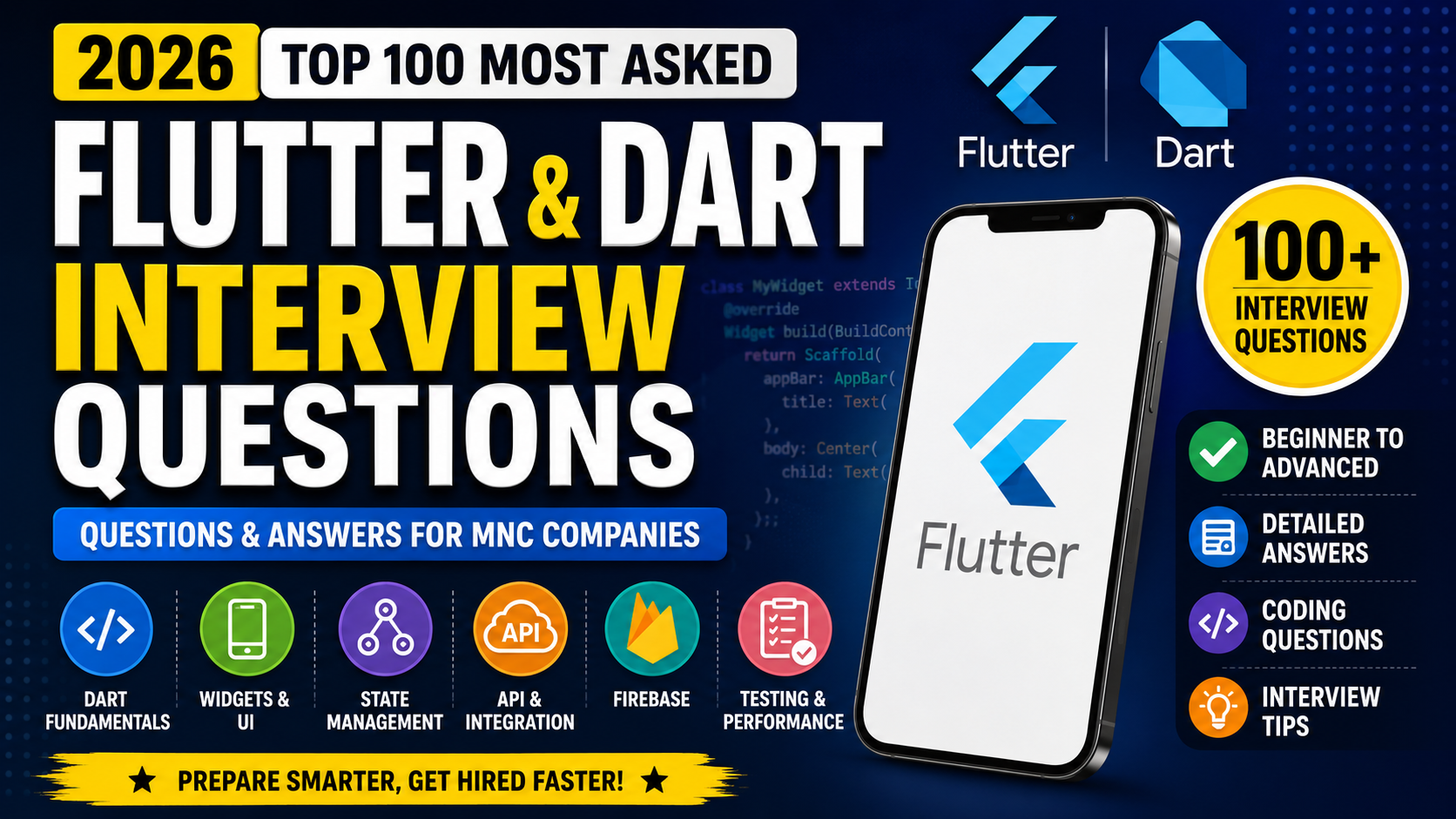
Flutter has become one of the most popular frameworks for cross-platform mobile app development. Companies around the world are hiring Flutter developers who understand not only Flutter widgets but also Dart programming, state management, architecture, performance optimization, testing, and deployment.
In this guide, you'll find the most commonly asked Flutter and Dart interview questions with answers. Whether you're preparing for your first job or an experienced developer interview, this article will help you crack your next Flutter interview.
Why Companies Prefer Flutter?
Flutter allows developers to build Android, iOS, Web, Windows, Linux, and macOS applications using a single codebase.
Benefits include:
- Single Codebase
- High Performance
- Beautiful UI
- Large Community
- Fast Development
- Hot Reload
- Excellent Documentation
Dart Interview Questions
1. What is Dart?
Dart is Google's object-oriented programming language used to build Flutter applications.
2. Why Flutter uses Dart?
Because Dart is optimized for UI development, supports Ahead-of-Time (AOT) and Just-in-Time (JIT) compilation, and provides excellent performance.
3. Difference between var, final and const?
var
Variable type is inferred.
var name = "John";
final
Assigned only once at runtime.
final age = 25;
const
Compile-time constant.
const pi = 3.14;
4. What are Null Safety features?
Null Safety prevents null reference exceptions.
String? name;
5. Difference between List, Set and Map?
List
- Ordered
- Duplicate values allowed
Set
- No duplicate values
Map
- Key-value pair
6. What is Future?
Represents an asynchronous operation.
7. What is async and await?
Used to perform asynchronous programming.
8. What is Stream?
A Stream delivers multiple asynchronous events.
9. Difference between == and identical()
== compares values.
identical() compares memory references.
10. What are Mixins?
Mixins allow code reuse without inheritance.
Flutter Basics
11. What is Flutter?
Flutter is Google's UI toolkit for building cross-platform applications.
12. What is Widget?
Everything in Flutter is a widget.
13. Difference between StatelessWidget and StatefulWidget?
StatelessWidget
Cannot change UI after creation.
StatefulWidget
Can rebuild UI when state changes.
14. What is BuildContext?
BuildContext identifies the location of a widget in the widget tree.
15. What is Hot Reload?
Updates UI instantly without restarting the application.
16. Difference between Hot Reload and Hot Restart?
Hot Reload
- Keeps state
- Faster
Hot Restart
- Clears state
- Restarts application
17. What is MaterialApp?
Root widget implementing Material Design.
18. What is Scaffold?
Provides app structure:
- AppBar
- Drawer
- BottomNavigationBar
- FloatingActionButton
- Body
19. Difference between Container and SizedBox?
Container supports decoration, padding, margin.
SizedBox only provides width and height.
20. What is MediaQuery?
Returns screen size information.
Widgets Interview Questions
21. Difference between Expanded and Flexible?
Expanded occupies all available space.
Flexible occupies only required space.
22. Difference between ListView and SingleChildScrollView?
ListView is lazy loaded.
SingleChildScrollView loads everything.
23. Difference between Column and ListView?
Column is non-scrollable.
ListView is scrollable.
24. What is Stack?
Displays widgets on top of each other.
25. What is Positioned widget?
Used inside Stack to position widgets.
26. What is Hero Animation?
Used for shared element transitions.
27. What is FutureBuilder?
Builds widgets based on Future data.
28. What is StreamBuilder?
Builds UI based on Stream updates.
29. What are Keys?
Keys help Flutter identify widgets efficiently.
Examples:
- ValueKey
- UniqueKey
- GlobalKey
State Management Questions
What is State Management?
Managing application state efficiently.
Popular options:
- Provider
- Riverpod
- BLoC
- Cubit
- GetX
- Redux
Difference between Provider and Riverpod?
Riverpod is safer and doesn't depend on BuildContext.
What is BLoC?
Business Logic Component separates UI and business logic.
Difference between Cubit and BLoC?
Cubit
- Simple
- Less boilerplate
BLoC
- Event-driven
- Better for large projects
API Interview Questions
Which package is commonly used?
- http
- dio
Why developers prefer Dio?
- Interceptors
- Logging
- Timeout
- File Upload
- Better Error Handling
What are Interceptors?
They intercept requests and responses before reaching the server.
Firebase Questions
Most asked topics:
- Firebase Authentication
- Firestore
- Realtime Database
- Cloud Messaging
- Analytics
- Crashlytics
- Storage
- Remote Config
Local Storage
Popular options:
- SharedPreferences
- Hive
- SQLite
- Drift
- Isar
Performance Optimization
Interviewers often ask:
- const constructors
- RepaintBoundary
- Lazy Loading
- Pagination
- Image Caching
- Widget Reuse
- Avoid unnecessary rebuilds
Clean Architecture Questions
Layers:
Presentation
↓
Domain
↓
Data
Advantages:
- Easy Testing
- Maintainability
- Scalability
- Better Code Structure
SOLID Principles
S – Single Responsibility Principle
O – Open Closed Principle
L – Liskov Substitution Principle
I – Interface Segregation Principle
D – Dependency Inversion Principle
Dependency Injection
Popular packages:
- GetIt
- Riverpod
- Injectable
Testing Questions
Types:
- Unit Testing
- Widget Testing
- Integration Testing
Advanced Flutter Questions
- Explain Flutter Rendering Engine.
- What is Widget Tree?
- What is Element Tree?
- What is Render Tree?
- Explain Flutter Lifecycle.
- What is SchedulerBinding?
- Explain Isolates.
- What is Platform Channel?
- What is Method Channel?
- Explain CustomPainter.
- Difference between InheritedWidget and Provider.
- Explain AnimationController.
- What is TickerProvider?
- How does Flutter compile code?
- Explain AOT vs JIT.
Coding Questions Asked in Interviews
- Reverse String
- Fibonacci Series
- Prime Number
- Palindrome
- Factorial
- Find Duplicate Values
- Sort List
- Remove Duplicates
- Binary Search
- API Call and Display List
- Login Screen
- Infinite Scroll Pagination
- Todo App
- Counter App using BLoC
- Weather App
- Shopping Cart
- OTP Verification
- Dark Theme
- Image Picker
- File Upload
HR Interview Questions
- Tell me about yourself.
- Why Flutter?
- Why should we hire you?
- Explain your latest project.
- Biggest challenge in Flutter?
- Team conflict example.
- Deadline handling.
- Future goals.
- Strengths and weaknesses.
- Why do you want to join our company?
Interview Tips
- Practice Dart coding daily.
- Build at least 5 real-world Flutter projects.
- Learn Firebase integration.
- Master state management (Provider, Riverpod, BLoC).
- Understand Clean Architecture.
- Learn Git and GitHub.
- Practice REST APIs with Dio.
- Learn SQLite or Hive.
- Know Flutter lifecycle.
- Revise OOP concepts.
- Prepare for coding rounds.
- Improve communication skills.
Recommended Project Ideas
- E-Commerce App
- Food Delivery App
- Expense Tracker
- Chat Application
- Quiz App
- Notes App
- Movie App
- Hospital Management App
- Cab Booking App
- Social Media App
Final Thoughts
Flutter interviews in 2026 focus on much more than widgets and layouts. Recruiters expect developers to have strong knowledge of Dart fundamentals, asynchronous programming, state management, architecture, API integration, Firebase, testing, performance optimization, and real-world project experience.
By mastering the questions covered in this guide and practicing hands-on projects, you'll be well-prepared for interviews at top MNCs and fast-growing startups. Keep your Flutter SDK updated, contribute to open-source projects, and continue building production-ready applications to stand out from other candidates.
Good luck with your Flutter interview preparation!